How to Increase Pharmacy Profit Margins: 7 Proven Strategies for Indian Pharmacy Owners in 2026
Discover 7 proven strategies to increase your pharmacy profit margins in India. Learn about inventory management, medicine margins, operational costs, and more.
Managing a profitable pharmacy business in India is a challenging task for pharmacy owners today. With the increasing cost of medicines, high competition, the need to comply with the Goods and Services Tax (GST), and the changing needs of customers, the profit margins for pharmacy owners are declining.
According to statistics, the average profit margin for a pharmacy business in India is between 8% and 15%. This is much lower than the profit margins for pharmacy businesses in the early 2000s. However, the good news for pharmacy owners is that there are strategies that can help them increase their profit margins without compromising the quality of the services offered to their customers.
In this article, we will discuss 7 strategies for increasing profit margins for pharmacy owners. With the use of the strategies discussed in this article, pharmacy owners can improve their profit margins regardless of the number of pharmacy businesses they operate.
1. Optimize Your Inventory Management (The Most Overlooked Strategy)
The Problem: According to pharmacy analytics across India, 20-25% of pharmacy revenue is tied up in slow-moving inventory. This is dead capital, tied up and not working for you.
The Solution: Optimizing your inventory management is critical for your bottom line. This is what high-performance pharmacy owners are doing in India:
A) Smart Stock Levels
- 1
Implement the ABC inventory management system. This means classifying your stock into A, B, and C categories
- 2
Monitor stock levels based on their sale velocities across different seasons and regions
- 3
Keep 60% of stock levels from category A, which accounts for 80% of your profit
- 4
Use data to avoid overstocking of seasonal stock
B) Reduce Expiry Losses
- 1
Expired stock is a loss of 3-5% of stock value for most pharmacy owners across India
- 2
Implement automatic expiry reminders for stock approaching 6 months of expiration
- 3
Work out return policies for stock approaching expiration dates
- 4
Implement a FIFO system for stock management
C) Track Stock Turnover Ratio
Formula for Calculation: (Cost of Goods Sold / Average Inventory Value) * 365
Target: To achieve an inventory turnover of 30-40 days. A pharmacy business is currently experiencing a stock turnover of 50 days. This means it is holding an extra Rs. 50,000 in stock, which is worth Rs. 10,000+ in dead capital.
Real Impact: A pharmacy business in Bangalore was able to reduce their inventory holding cost by 18%, which immediately released Rs. 1.5 lakhs in working capital, which is equivalent to profit for the business.
2. Master the Art of Medicine Margin Management
Why This Matters: The vast majority of pharmacy business owners treat all medicines in the same way when it comes to their margins. This is a critical mistake.
A) Categorize Medicines by Margin Potential
- 1
High-margin medicines (15-25% margin): Pharma company exclusive brands, new molecules
- 2
Medium-margin medicines (8-12% margin): Generic alternatives, commonly prescribed drugs
- 3
Low-margin medicines (3-8% margin): Essential/schedule H medicines, price-controlled drugs
B) Smart Pricing Strategy for India
- 1
Medicines under price control have a government-set margin, capped at 20% for branded and 50% for generics
- 2
For non-controlled items, avoid copying competitors’ prices. Instead:
- 3
Add a 15-20% margin for branded pharmaceuticals
- 4
Add a 25-35% margin for branded OTC
- 5
Add an 8-12% margin for popular generics
- 6
Add a 20-25% margin for health supplements and nutraceuticals
C) The Bundle Strategy
Pharmacy owners in metros and tier-1 cities are using this strategy, packaging low-margin essentials with complementary items of higher margin. Example: Pairing an antibiotic of lower margin with health supplements of higher margin. Result: Increases average transaction value without customer resistance.
Pro Tip: Pharmacy management software can help you analyze and increase overall pharmacy margin by 2-3%
3. Reduce Pharmacy Operational Costs (Without Cutting Quality)
The Opportunity: Most pharmacy owners in India are spending more on pharmacy operations than they should, but are unaware of it
A) Optimize Staff Productivity
- 1
Hire staff based on location demand—single pharmacist for stores with 200-300 customers per day, additional staff as required
- 2
Implement automated billing systems—saves 2-3 hours per day
- 3
Cross-train staff for multiple roles
Result: Reduce staff cost per transaction by 15-20%
B) Reduce Wastage and Pilferage
- 1
Institute a daily stock audit
- 2
Install CCTV cameras in areas of high pilferage (ironically, the highest rate of wastage comes from the removal of expiry date stickers and stock misplacement, causing 5 to 8% stock loss)
- 3
Install digital pharmacy systems to monitor who has accessed which medicine and at what time
Impact: Reduce wastage levels to under 1%, as against the current level of 3 to 5%.
C) Optimize Rent and Utilities
- 1
Renegotiate rent on an annual basis, depending on the performance of the pharmacy and the current market rate
- 2
Install LED bulbs
- 3
Install smart air-conditioning systems that vary the rate of air-conditioning depending on the footfall
Savings: ₹5,000 to ₹15,000 per month, depending on the size of the pharmacy.
D) Negotiate Better Supplier Terms
- 1
Consolidate suppliers: work with fewer, bigger suppliers to negotiate better rates
- 2
Negotiate payment terms of 15 to 30 days, as against the current COD terms
- 3
Pharmacy cooperatives are also available, which can be joined to negotiate better terms
Savings: negotiate 3 to 5% better purchase prices.
4. Increase Average Transaction Value (ATM)
The Math: Assume your current ATM is ₹500, and you do 100 transactions per day, resulting in ₹50,000
A) Upselling Strategy
- 1
Pharmacist Training: When a customer buys antibiotics, suggest related supplements
- 2
For chronic disease medicine: Suggest blood pressure monitors, glucose meter strips, health drinks
- 3
For children's medicine: Suggest vitamin supplements, health tonics
- 4
Studies have shown that a well-trained staff can increase ATM by 8-12%
B) Cross-selling High-Margin Products
- 1
Expand business: Health and wellness products, Vitamin supplements, protein powder, cosmetics
- 2
Over-the-counter medicine: Pain relief gels, Wound care, First aid kit
- 3
Masks, Sanitizers, Tissues: These can be sold with a 50-60% profit
- 4
Note: These must be in compliance with the state's pharmacy regulations
C) Design Medicine Combos/Packages
- 1
Diabetes Care Kit: Meter, Strips, Lancets, Log Book
- 2
Cold & Cough Kit: Syrup, Tablets, Lozenges, etc.
- 3
Women's Health Kit: Period pain relief, Vitamin supplements, hygiene products
This will increase customer satisfaction as well as the profit margin.
D) Implement Loyalty Program
- 1
Using a digital management system for a pharmacy, customer loyalty can be tracked
- 2
Reward points can be given for every purchase made
- 3
Pharmacies in different cities in India report a 15-25% increase in customer lifetime value
- 4
Cost: Minimal, as automated systems are used.
5. Leverage Premium and Specialty Pharmacy Services
The Trend: Indian pharmacy customers are increasingly willing to pay for convenience and specialized services.
A) Delivery Services
- 1
Pharmacies in India are offering same-day delivery services
- 2
Markup delivery orders by 5-8%
- 3
Pharmacy management software can be used for smooth integration with the delivery service
Opportunity: Increase daily revenue by 8-12%
B) Online Pharmacy Operations
- 1
Open your own website or use platforms (if permitted by law in your state)
- 2
Online sales have a higher ATM compared to counter sales
- 3
Inventory management can be integrated for smooth running
Return on Investment: Pharmacies can expect 15-20% increase in daily revenue
C) Specialized Services
- 1
Medication counseling: Offer detailed medicine interaction counseling for a fee of ₹50-100
- 2
Health camps: Partner with diagnostic centers for health camps on diabetes and high blood pressure
- 3
Medicine subscription: Offer medicine subscription for chronic disease medicine, ensuring regular sales
- 4
Immunization: (If permitted by law in your state) High-margin business with regular income
D) Corporate/Institutional Sales
- 1
Tie up with companies, schools, NGOs for medicine supply
- 2
Offer 5-8% discount on bulk orders, still maintain high margins
6. Use Data and Technology to Identify Hidden Profit Opportunities
Why It Matters: Most pharmacy owners operate without sufficient data on their business.
A) Analyze Sales Patterns by Category
- 1
Which categories of medicines sell best in your region?
- 2
What is the profit for each category, considering returns, expiration, and wastage?
- 3
Allocate shelf space based on profit, not popularity alone
Insight: Category selling 1000 units with a 3% profit may not be as profitable as selling 200 units with an 18% profit.
B) Track Customer Segments
- 1
Who are your high-value customers (spend over ₹5,000 per month)?
- 2
What do your chronic diseases need, as they will come back for repeated purchases?
- 3
Can you segment your customers based on areas within your city?
Insight: Medicine preferences may differ between areas within a city.
C) Monitor Competitor Pricing Strategically
- 1
How many of the top 10-15 best-selling medicines of your competitors do you sell?
- 2
Do not compete on price for all products—be strategic.
- 3
If a competitor is low on a popular generic, offer a bundle discount.
- 4
Can you use a pharmacy software that helps you monitor competitor prices?
D) Identify Seasonal Opportunities
- 1
Which medicines sell best in different seasons?
- 2
Cough and cold medicines sell best between October and February.
- 3
Anti-diarrheal medicines sell best during the monsoon season.
- 4
Vitamin supplements sell best during exam season.
7. Streamline Operations with Pharmacy Management Software
The Reality: Manual pharmacy operations are costing you 3-5% of potential profits.
A) Eliminate Manual Billing Errors
- 1
Manual billing errors result in a loss of ₹500-₹2,000 every month due to loss of records
- 2
Manual billing errors are reduced by 70% with automated systems
- 3
Every transaction counted = every profit counted
B) Real-Time Inventory Insights
- 1
Know exactly what’s in stock, what’s expiring, and what’s not selling well
- 2
Reduce emergency expedited orders (higher costs)
- 3
Purchase medicines based on data, not guesswork
- 4
Cost savings: ₹1,000-₹3,000 every month
C) GST and Compliance Automation
- 1
Ensure all medicines are classified for GST (0% for essential medicines, 5% for other medicines)
- 2
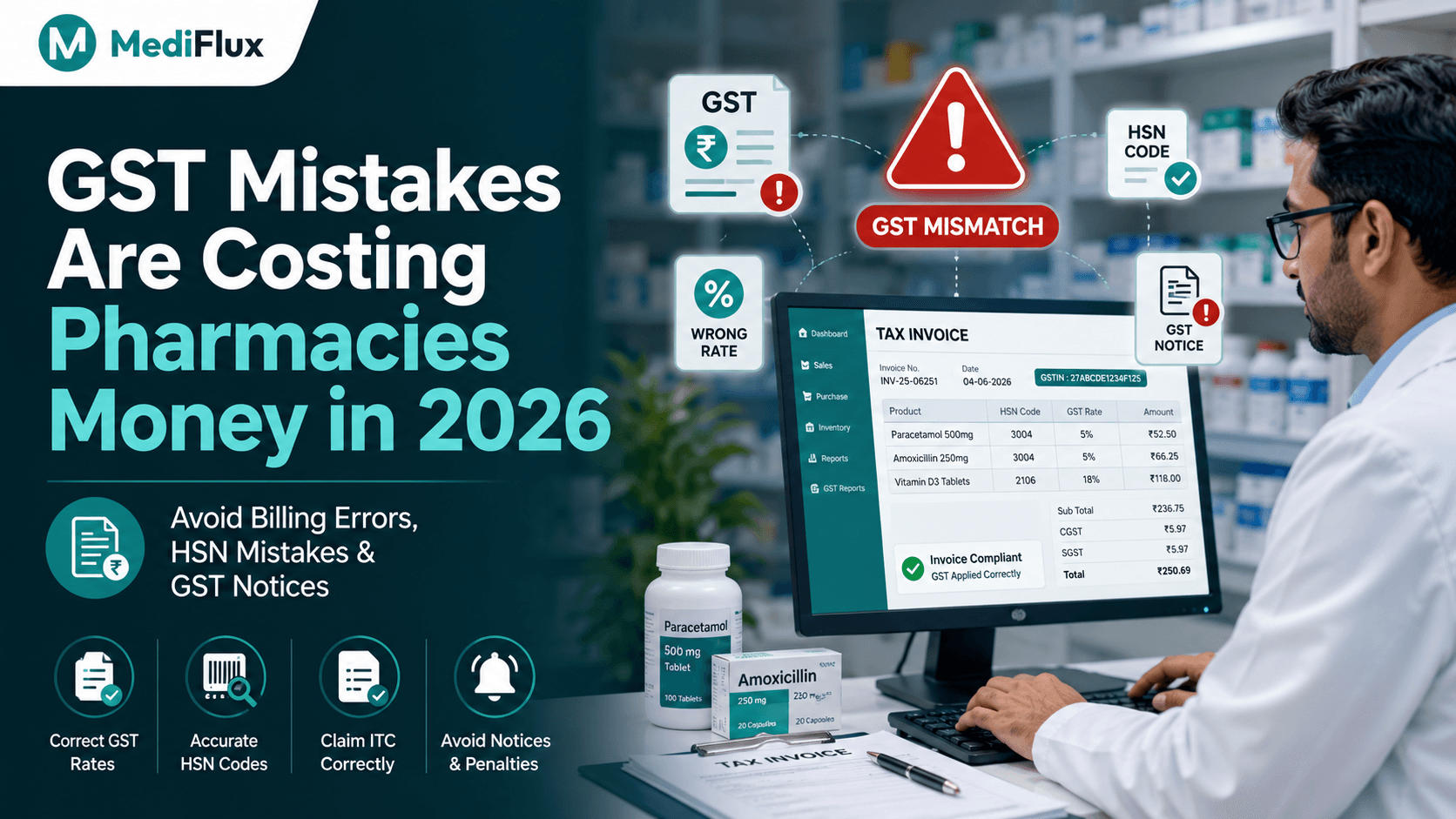
Automated GST calculation reduces compliance errors and penalties
- 3
Comply with digital record requirements set by tax authorities
D) Customer Management
- 1
Recognize repeat customers and their purchase history
- 2
Recognize high-value customers for special attention
- 3
Send automated reminders for refills of chronic medicines
- 4
Result: Increase repeat customer revenues by 15-25%
E) Generate Actionable Reports
- 1
Profit margin by medicine, category, and time period
- 2
Daily/weekly/monthly sales trends
- 3
Inventory turnover and inventory costs
- 4
Benefit: Make smarter choices with data
Implementation Timeline
Week 3-4: Medium-Term Changes
- 1
Implement ABC inventory categorization
- 2
Train staff on upselling strategies
- 3
Establish basic customer tracking mechanisms
Month 2: Systems Implementation
- 1
Change over to digital pharmacy management software (most companies offer a 30-day free trial)
- 2
Establish expiry date alerts
- 3
Track margin by category
Month 3 Onwards: Optimization
- 1
Develop specialty services
- 2
Establish loyalty programs
- 3
Continuously analyze results and adapt strategies accordingly
Conclusion: Your Pharmacy’s Profit Potential is Higher Than You Think
The pharmacy business in India is changing rapidly. The needs of the customer are changing, the regulatory environment is becoming increasingly complex, and competition is increasing. However, it is exactly these times when operational excellence and strategies make the difference between successful pharmacy businesses and struggling ones.
With the implementation of only 3-4 of the strategies presented, the pharmacy business can realistically achieve the following:
- 1
Increase its profit margin by 2-4%
- 2
Reduce operational headaches by 40-50%
- 3
Build a more sustainable and scalable pharmacy business
- 4
Deliver better customer relationships and loyalty
The time to take action is now. Start with the area where your pharmacy business is currently experiencing the most pain, and work through the strategies presented in the playbook.
Also, remember, increasing the profit margin by only 2% for your pharmacy business with a monthly revenue of ₹50 lakhs will result in an increase of ₹10,000 every month, or ₹1.2 lakhs every year.
What strategy will you implement first? Let us know in the comments. We would love to know how these strategies work for your pharmacy business in the various regions of India.
FAQs: Pharmacy Profit Margin Management
About MediFlux
MediFlux is India’s #1 pharmacy management software, helping pharmacy business owners across Srinagar, Kanyakumari, and all cities in between, achieve higher profitability through optimized inventory, billing, GST, and much more. With our pharmacy software, implementing these profit-boosting strategies has never been easier.
Was this article helpful?
Help us improve by giving your feedback.