How MediFlux Protects Your Pharmacy's Data: Inside Our Security Practices
MediFlux takes pharmacy data security seriously. Learn how we protect your store with OWASP-aligned engineering, role-based access, audit logging, regular penetration testing, encryption, and a dedicated QA team.
A pharmacy management system doesn't just store sales numbers. It holds patient prescriptions, customer phone numbers, GST and financial records, and staff access credentials, sometimes for years. If that data is mishandled, the damage isn't limited to a bad review; it can mean compliance violations, financial loss, and broken trust with the very customers a pharmacy depends on. At MediFlux, we built security into the product from day one, not as an afterthought bolted on after launch.
This post walks through exactly what that means in practice, not vague reassurances, but the specific systems, processes, and people working to keep your pharmacy's data safe every single day.
Security at a Glance
- 1
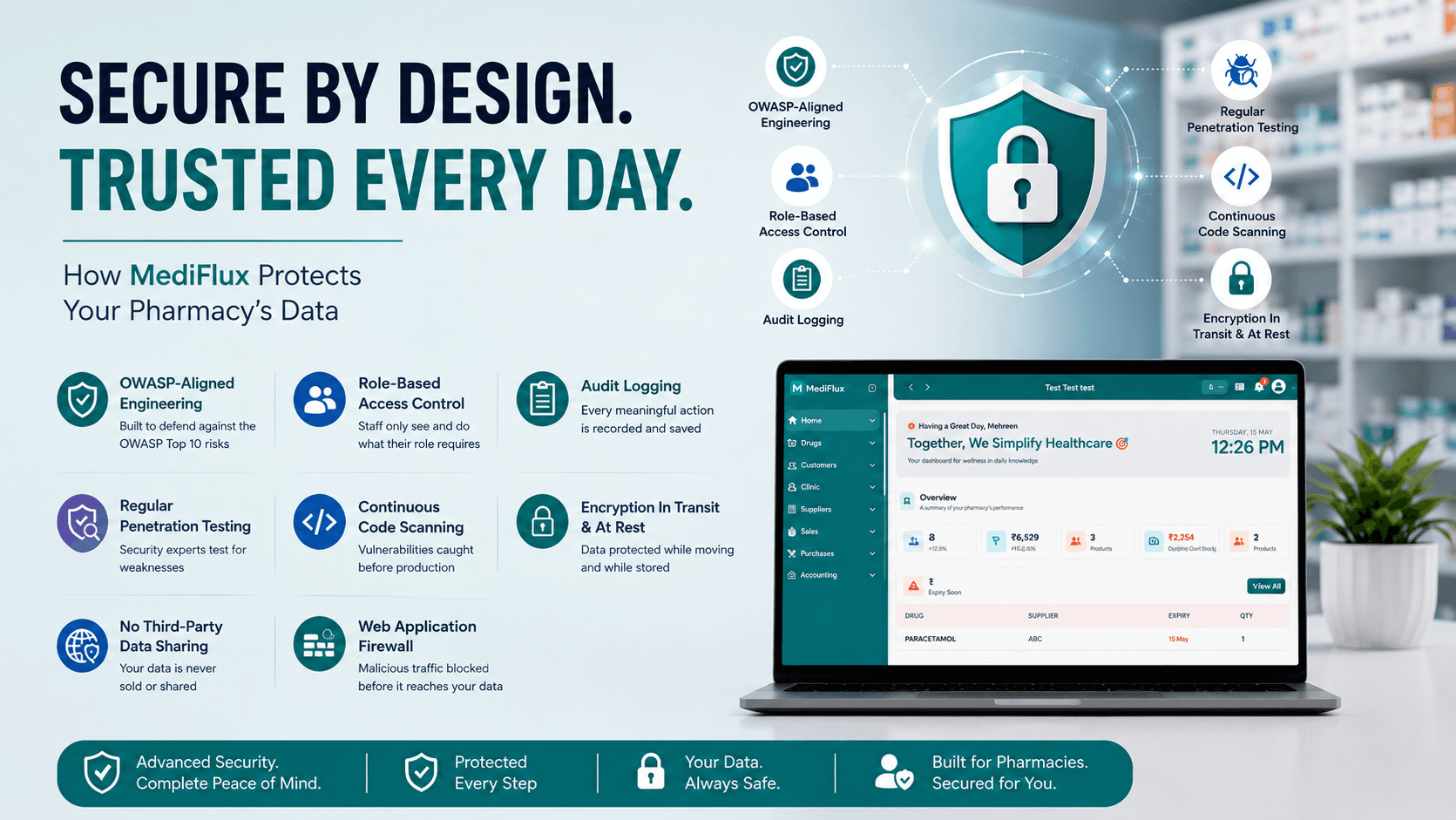
OWASP-Aligned Engineering : Built to defend against the OWASP Top 10 critical web risks
- 2
Role-Based Access Control: Staff only see and do what their role requires
- 3
Audit Logging: Every meaningful action is recorded and saved
- 4
Regular Penetration Testing: Security professionals actively test for weaknesses
- 5
Continuous Code Scanning: Vulnerabilities caught before code reaches production
- 6
Dedicated QA Security Testing: Our QA team actively validates security controls, not just features
- 7
No Third-Party Data Sharing: Your data is never sold or shared
- 8
Web Application Firewall: Malicious traffic filtered before it reaches your data
Engineering Against Known Risks: OWASP Top 10
The OWASP Top 10 is the industry's most widely referenced list of critical web application security risks, covering issues like injection attacks, broken access control, cryptographic failures, and security misconfiguration. Rather than treating this as a checklist to glance at once, MediFlux's development practices are built around defending against these categories at every layer. Security reviews against this framework happen as part of our regular development cycle, not as a one-time exercise.
- 1
Injection Attacks: Prevented through input validation and parameterized database queries
- 2
Broken Access Control: Blocked through strict server-side authorization checks on every request, not just hidden buttons in the interface
- 3
Security Misconfiguration: Reduced through secure default settings and regular configuration reviews
Role-Based Access Control: The Right Access, for the Right Person
Not everyone on your staff needs the same level of access, and MediFlux is built around that reality. Each role gets permissions scoped to what the job actually requires, which directly limits the damage a compromised account or an honest mistake can cause, since access is never broader than necessary.
- 1
Owner / Admin: Full access to billing, inventory, financial reports, and staff permissions
- 2
Staff: Day-to-day store operations such as billing and inventory updates, without access to financial reports or staff management
- 3
Sales Person: Access limited to processing sales and generating bills at the counter
- 4
Accountant: Access to financial and GST reports, without inventory or staff controls
Note: These permissions are enforced on our servers, not just hidden in the interface, so a staff member can't get around them by guessing a URL or using the app in an unexpected way.
Audit Logs: Every Action, Recorded and Saved
Every meaningful action taken inside MediFlux is recorded in a persistent audit log that captures who did what and when, and these logs are saved, not just generated and discarded. If a discrepancy ever needs investigating, there is a clear, tamper-resistant trail to refer back to.
- 1
Bill creation, edits, and deletions
- 2
Inventory and stock adjustments
- 3
Staff permission changes
- 4
Manage active devices, review login activity, and revoke access from unfamiliar sessions.
- 5
Financial report views and exports
Regular Penetration Testing
Automated tools catch a lot, but they don't think like an attacker. That's why MediFlux undergoes regular penetration testing, where security professionals actively attempt to break into the system the same way a real attacker would: probing for weak authentication, testing for injection points, and looking for ways to escalate privileges or access data they shouldn't. Findings are tracked and resolved on a defined timeline, not left open indefinitely.
Continuous Code Scanning
Before code reaches production, it passes through automated security scanning designed to catch vulnerabilities early, including insecure coding patterns, outdated dependencies with known vulnerabilities, and exposed secrets or credentials.
Note: This scanning runs automatically on every code change, so catching a vulnerability doesn't depend on someone remembering to check for it manually.
A QA Team That Actively Tests
Behind every release, our QA team is actively involved in validating that security controls work as intended, not just that features function correctly. This means manually testing role permissions to confirm staff genuinely can't access what they shouldn't, verifying that audit logs capture what they're supposed to, and probing new features for edge cases before they reach pharmacies. Security testing at MediFlux isn't a separate, occasional audit; it's a continuous part of how every update gets built and shipped.
Web Application Firewall: A Filter Before Anything Reaches Your Data
In front of the application itself, a web application firewall filters incoming traffic before it ever reaches MediFlux's servers, acting as a first line of defense that reduces the load on every other security layer behind it.
- 1
SQL injection attempts
- 2
Cross-site scripting (XSS)
- 3
Malicious bot traffic and scraping
- 4
Distributed denial-of-service (DDoS) patterns
Note: This layer blocks a large share of automated attack traffic before it ever reaches the application itself, so the systems described above are dealing with a much smaller, more targeted set of threats.
Security Is a Practice, Not a One-Time Promise
None of the systems above work in isolation, and none of them are "set once and forgotten." OWASP-aligned engineering, role-based access, audit logging, penetration testing, code scanning, an actively engaged QA team, encryption, and a web application firewall all work together, continuously, to protect the pharmacies that trust us with their data. Security isn't a feature we built once. It's a discipline we maintain every day, because the pharmacies running on MediFlux deserve nothing less.
FAQs About MediFlux Security
Was this article helpful?
Help us improve by giving your feedback.